Born in Cambridge Mural in Kendall Square
About the Mural
This mural, created in 2026, features just a few of the breakthroughs that happened in and around Kendall Square over the past century — many of which you’ll learn about on a tour of The Innovation Trail. There are three spots for you to snap photos. If you do, tag us (@bostoninnotrail on Instagram + X, The Innovation Trail on Facebook.) And we’d love to see you soon for one of our public tours or special events… or a custom group tour!
To find this mural, enter the lobby of 355 Main Street, go straight through to the back doors, and turn right. Or stand at the entrance to the Marriott Hotel, with Main Street behind you, and turn left.
Mural Description
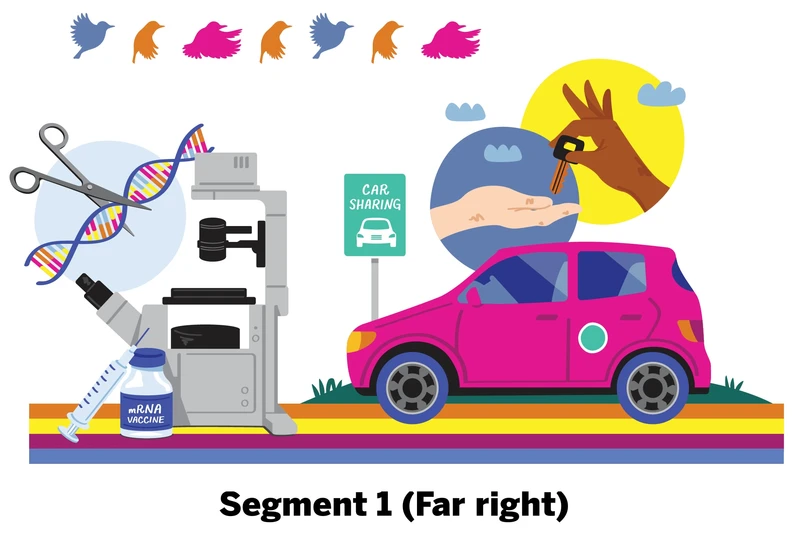
Segment 1 (far right)
Zipcar married the concept of car sharing with all the technology available in 2000, when it was founded in Cambridge by Robin Chase and Antje Danielson. You reserved online, and your RFID “Zipcard” unlocked the car. (Earlier services often used lockboxes, key cabinets, or paper logbooks.) Zipcar’s in-car telematics tracked usage and handled access automatically, which made the economics work as the company scaled up. Zipcar went public in 2011, and today has vehicles in more than 500 cities and towns across North America and Europe, as well as on over 400 university campuses.
This segment also includes a reference to Harold “Doc” Edgerton’s pioneering work at MIT in the 1930s with high-speed cameras and strobe lighting, which captured birds in motion; balloons bursting; and bullets going through apples. (Birds flying at top.) The DNA helix, microscope, and mRNA vaccine bottle honor a half-century of biotech innovation in Kendall, from some of the earliest biotech companies like Biogen to COVID-19 vaccines developed by Moderna to today’s work at the Broad Institute to advance the use of gene editing in treating diseases.
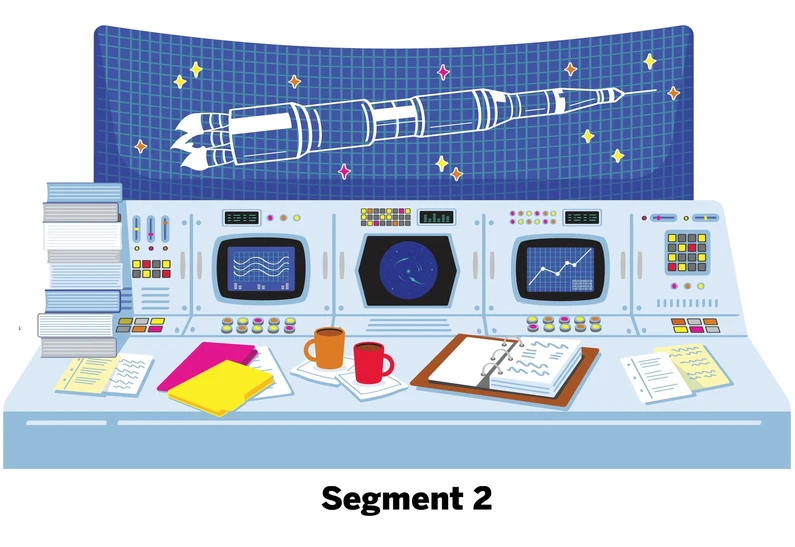
Segment 2
How is Cambridge connected to the moon? If not for the team at the MIT Instrumentation Lab, Apollo spacecraft would not have had the guidance computers or software to make their way from Earth to the surface of the moon. That lab was spun out from MIT in 1973, but it is still active, now called Draper Labs after its founder, Charles Stark Draper. It provided navigation systems for the Space Shuttle, and today is working with NASA on its Artemis program to return humans to the moon. One of the software engineering leaders at the MIT Instrumentation Lab was Margaret Hamilton, and in this segment of the mural, you can recreate a famous photo of her standing next to a printout of the Apollo guidance software.

Easter egg: If you look at the center screen at the Mission Control desk, you’ll find that someone was playing “Spacewar!” Developed by students at MIT in 1962, it was the first interactive videogame, helping inspire the creation of Atari and spark the growth of the videogame industry.
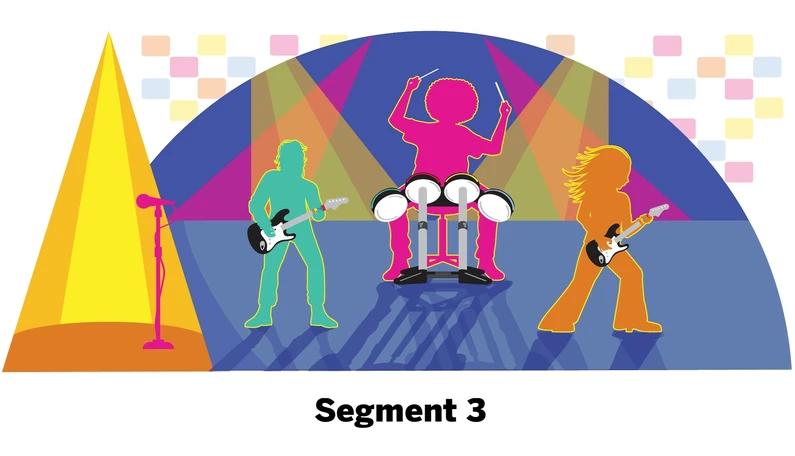
Segment 3
The videogame company Harmonix was founded in 1995 by two MIT graduates who had met at the university’s Media Lab. The company spent a decade producing music-related videogames before Guitar Hero was released in 2005. That game gave players a plastic guitar as a controller, and challenged them to keep up with msuical notes flying by on the screen. Guitar Hero sold millions of copies and launched a billion-dollar franchise. Harmonix followed it up with Rock Band, which included more instruments and a collaboration with The Beatles, and Dance Central. In 2021, Harmonix became part of Epic Games — and a Boston-based team of game developers now work on concerts and music-related experiences in the Fortnite universe, including Fortnite Festival.
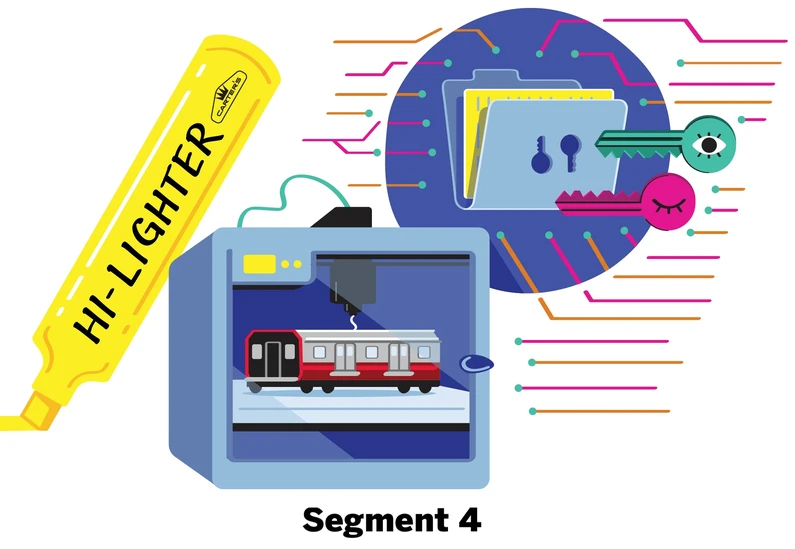
Segment 4
The highlighter marker (left) was invented in East Cambridge in 1963 by Frank Honn, vice president of technology at Carter’s Ink Company. Honn was doing quality control on the company’s markers when he ran a translucent yellow marker across a page of type, and saw that the words jumped out instead of disappearing. In the late 1980s, MIT professors Emanuel Sachs and Michael Cima developed one of the first practical 3D printers (center), patented in 1993, using an inkjet printer head that could progressively create objects by spitting out ceramic powder and a “glue” of colloidal silica. Startups such as Z Corporation licensed the technology and commercialized it. Harvard researchers have since pushed the technology into biology, with Jennifer Lewis’s lab printing living tissue laced with blood vessels. The Cambridge nonprofit Fab Foundation, headquartered in the buildng above you, has helped train students worldwide to use 3D printers (and other digital tools) to bring their ides to life. And in 1977, three MIT researchers, Ron Rivest, Adi Shamir, and Leonard Adleman, devised RSA, the first practical public-key encryption system (right). RSA made it possible to send secure messages to strangers without first sharing a secret key, it became the basis for secure online shopping and banking.
Segment 5
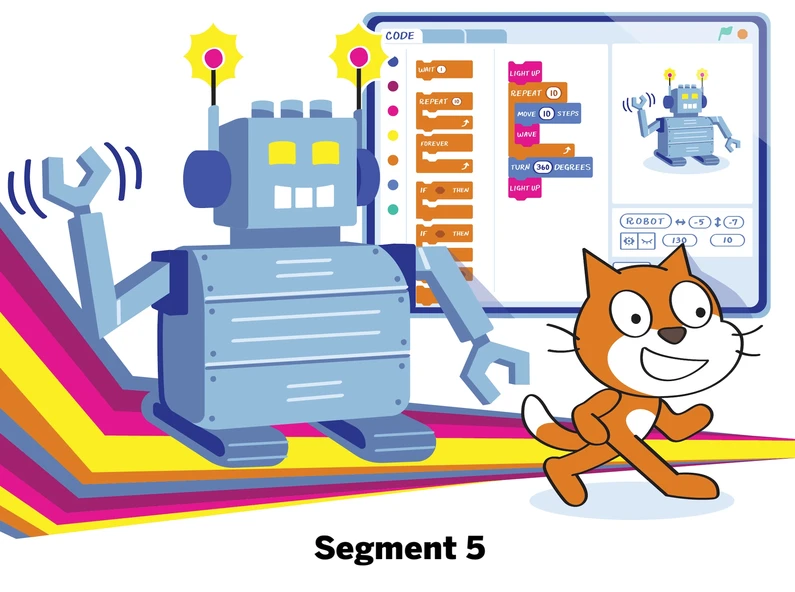
MIT has been a hub for robotics (left) since the 1950s. Its spinouts have since put millions of robots into homes, factories, and labs. iRobot, founded in 1990 by AI Lab alumni Rodney Brooks, Colin Angle, and Helen Greiner, launched the Roomba in 2002, and the company has sold more than 50 million robots worldwide. Boston Dynamics grew out of Marc Raibert’s Leg Lab at MIT in 1992; became famous for viral YouTube videos of robots that run, jump, and dance; and now sells the dog-like Spot and builds the Atlas humanoid for factory work. Cambridge has also given birth to Harvard’s RoboBee and Kilobots swarm robots and the Logo “turtle,” MIT professor Seymour Papert’s floor robot, which children programmed to draw shapes. It is an ancestor of both LEGO’s Mindstorms robotics kits and the Scratch programming language. MIT was also the birthplace of student robot building competitions that evolved into the worldwide FIRST Robotics Competitions.
Scratch (right), the colorful block-based programming language, has introduced a generation of kids to coding. It was developed by Mitchel Resnick’s Lifelong Kindergarten group at the MIT Media Lab. It launched in May 2007 as a downloadable desktop application, letting children snap together code blocks like Lego bricks to make games, stories, and animations — and share and “remix” them with an online community. The release of Scratch 2.0 in 2013 brought it to the web and set off explosive growth. Scratch has reached more than 140 million children around the world who have created more than a billion projects with it. Scratch Cat is Scracth’s mascot.
Segment 6 (far left)
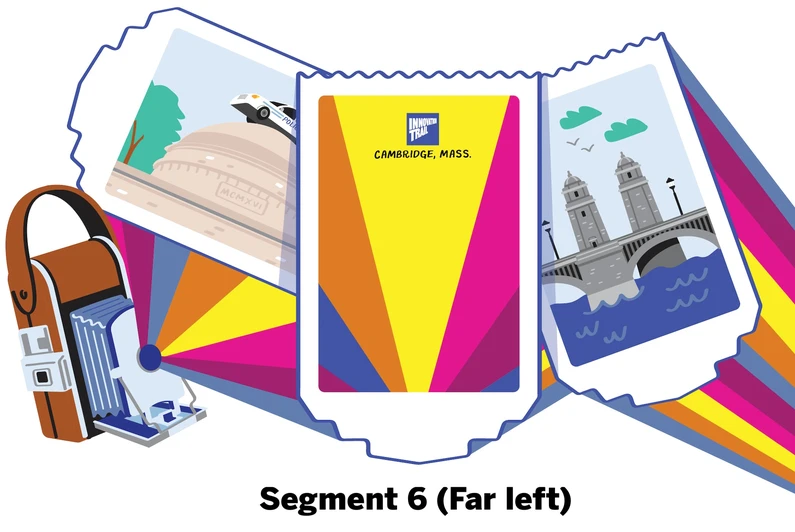
Edwin Land, a two-time Harvard drop-out, invented the first instant camera while working in Cambridge, and maintained his private research lab just a few blocks from here, at 700 Main Street. The Polaroid camera first went on sale in 1948 at the Jordan Marsh department store in Boston, and its success created thousands of jobs in Massachusetts over the next few decades.
MIT’s Great Dome was built in 1916, as the university was establishing its Cambridge campus after moving here from Boston. It has often been the site of student “hacks,” or pranks, like parking a police car atop it, turning the dome into R2-D2, or building a replica of a Red Line subway car that used solar power to circumnavigate the dome.
The Longfellow Bridge connects Cambridge with Boston. There has been a bridge here since 1793, and it led to the development of this neighborhood as an industrial center in the 1800s. Among the manufacturers located here were 66 different candy makers, as well as the Kendall Tank & Boiler Co., a maker of steam boilers, which were used to power factory equipment in the days before electricity. Kendall Square is named after that company’s founder, Edward Kendall.
About the Artist
Julia Emiliani is an award-winning freelance illustrator & designer living in Boston. She has created many other vibrant and eye-catching murals around the city, both indoors and outdoors. Julia is a graduate of the Massachusetts College of Art and Design. You can follow her on Instagram.
About the Mural Supporters
BXP is the largest publicly traded developer, owner, and manager of premier workplaces in the United States. BXP envisions, develops, and manages exceptional properties that enhance client success, strengthen communities, and advance opportunity.
The Innovation Trail is a nonprofit organization focused on chronicling four centuries of Boston-area breakthroughs in science, technology, medicine, and more. While Boston is well-known for its Revolutionary history, the Innovation Trail shares the lesser-known stories of the innovators and innovations that made Boston the city it is today. The Innovation Trail offers self-guided tours, walking tours, and special events throughout the year.
Thanks
Thanks to Karen Weintraub and Michael Kuchta, the authors of the book Born in Cambridge, for allowing us to “borrow” their title, and for their input on the mural’s content. Thanks to Joel Smith and the team at Cambridge Redevelopment Authority for their support and guidance.
Check out our newest mural in Kendall Square, commissioned by BXP in partnership with The Innovation Trail
Find it near the Kendall Square MBTA stop, Kendall Square Green Garage, and the Marriott hotel, in the indoor passageway known as Pioneer Way.